
Italian Football: The Anatomy of a Decline
- Yoann Brigante
- 20 avr.
- 22 min de lecture

How structural dysfunction, governance failure, demographic headwinds and a culture
resistant to change have progressively weakened one of football’s historic powers and narrowed the path to renewal
1. A third consecutive World Cup absence: not an accident, but a verdict
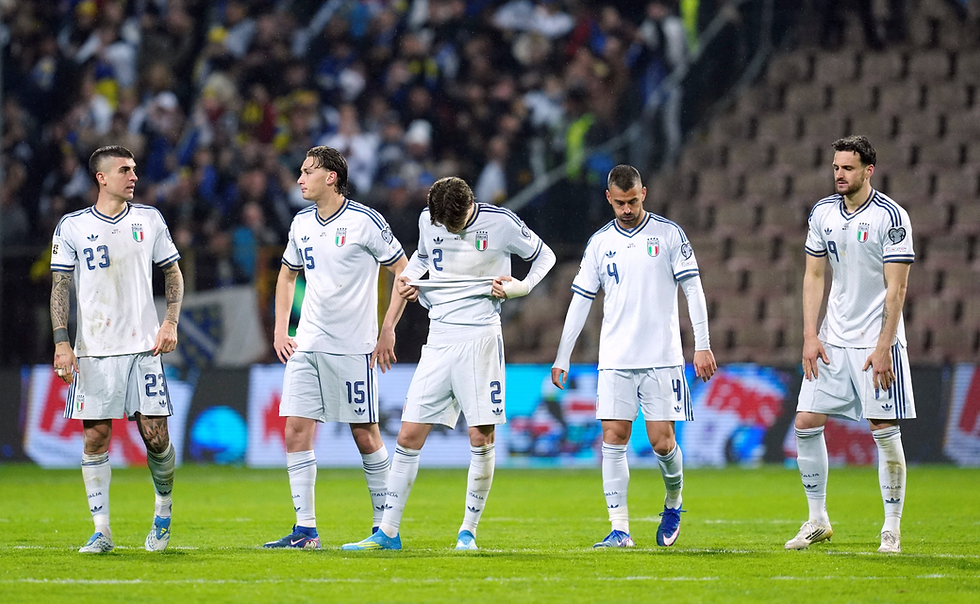
For the third consecutive time, Italy will not compete at a FIFA World Cup. The loss to Bosnia-Herzegovina on penalties confirmed what the footballing world had long suspected: the Azzurri's decline is no longer episodic. It is structural. The resignations of FIGC president Gabriele Gravina and of coach Gennaro Gattuso, and the hasty shelving of a parliamentary hearing on the state of the game are not isolated governance crises. They are symptoms of a system that has been weakening structurally for many years and is now confronting the consequences.
In 2006, Italy won the World Cup in Berlin. That team, ageing, scandal-tainted by Calciopoli, and built around a generation of exceptional individuals, can now be read, in retrospect, as masking weaknesses that were already beginning to emerge. Fifteen years later, Roberto Mancini's side won the European Championship in 2021, a genuine collective achievement that briefly obscured the structural deterioration underneath. But the Euro 2020 triumph, celebrated at Wembley, proved to be a remission rather than a recovery. Mancini himself resigned in August 2023, in a context of growing uncertainty about the direction and support behind the project. Three World Cup absences now constitute the most visible proof that what is broken goes far deeper than tactics, coaches, or a single bad qualifying cycle.
The central question is no longer whether Italian football is in decline. It is whether Italian football has the institutional capacity, the financial discipline, and the cultural willingness to reverse it.
2. The numbers are damning and self-documented.
In April 2026, the FIGC itself published a sweeping report on the state of Italian football, presented by the outgoing president largely as an account of external constraints weighing on the system rather institutional failure. What it constitutes, when read alongside the broader evidence, is the most comprehensive acknowledgments yet of the scale of Italian football’s structural problems.
Italian players account for only 32.1% of minutes played in Serie A, placing Italy sixth-worst in Europe for foreign player exposure. More striking still: Serie A ranks 49th out of 50 monitored leagues worldwide for the percentage of minutes played by eligible Under-21 players, at just 1.9%. Of the 284 players who averaged at least 30 minutes per Serie A match at matchday 31 of the current season, only 89 are Italian, and ten of those are goalkeepers.
The economic picture is equally sobering. Professional Italian football continues to lose over €730 million per year. Total professional club debt stands at €5.5 billion, with revenues now covering only 83% of that indebtedness, down from 97% in 2007/08.
Agent fees, meanwhile, hit an all-time high in 2025, surpassing €300 million, with significant increases even in Serie B and Serie C. Italy has 97 professional clubs, a number exceeded globally only by Mexico, Turkey, Argentina, Thailand, and Saudi Arabia. The system is hypertrophic and economically unsustainable.
On the technical side, Serie A ranks last among Europe's top five leagues for dribbles per match, for pressing intensity, and for average ball speed, 7.6 m/s compared to 10.4 m/s in the UEFA Champions League. The game being played in Italy is, by measurable standards, slower, less dynamic, and less technically demanding than at the European elite.
Italy is also last among major European football nations for investment in youth development, measured by the value generated over the past decade from international transfers of domestically trained players, behind France, Spain, Portugal, the Netherlands, England, and Germany.
3. Calciopoli: the wound that never healed
Any honest account of Italian football's decline must begin with Calciopoli. In 2006, the same year Italy lifted the World Cup trophy, Italian football was engulfed in its most far-reaching corruption scandal: a scandal centred on the manipulation of refereeing appointments and one that raised profound questions about the governance culture surrounding Serie A.
The sporting consequences were significant: Juventus were relegated to Serie B and stripped of two scudetti, while other clubs received points deductions. But the deeper damage was reputational, institutional, and cultural. Calciopoli exposed the extent to which private interests, informal influence and opaque relationships could distort the governance environment of Italian football.
Trust in Italian football's institutions was severely damaged..
Domestic audiences disengaged.
International perception deteriorated (impacting investment).
A generation of talented young players and coaches came of age in a system whose credibility had been seriously weakened.
The 2011 appeal proceedings, which resulted in partial rehabilitations and further controversy, did not resolve the underlying questions: they amplified them.
What Calciopoli revealed, and what subsequent events have confirmed, is a culture of factional self-interest within Italian football's governing structures that consistently prioritises the maintenance of existing power arrangements over the pursuit of collective reform. That culture did not end in 2006. It appears to have persisted, albeit in different and less spectacular forms.
4. A governance system designed to prevent reform
The FIGC's own report inadvertently illuminates the central paradox of Italian football's governance: a federation with nominally broad powers, whose president was re-elected with 98.7% of the vote, has nonetheless struggled to deliver the kind of structural reforms that many observers have considered necessary for years.
The explanation lies in the architecture of the system itself. The FIGC's Federal Council includes more stakeholders with divergent interests than any comparable national federation in Europe. The 2024 "Mulè amendment", a parliamentary intervention ostensibly designed to redistribute power within football governance, effectively entrenched a veto right for the professional leagues over fundamental reform. As of the current season, the seventeenth (!) draft of a proposed league restructuring sat on the table, unable to achieve the three-quarters majority required for approval.
The proposed reforms, reducing Serie A and Serie B to 18 clubs each, cutting the hypertrophic professional tier of Lega Pro, reforming promotion and relegation structures, have been on the agenda since February 2020. They remain unimplemented. The interests of Lega Pro and the amateur football structures, which provide the political base for the federation president's election, have consistently outweighed the structural imperatives of the national team and the professional game.
Gravina's report blames legislative constraints, club autonomy, and government inaction. A number of Italian commentators have argued, in response, that the federation’s room for manoeuvre was greater than the report implies [1]: even allowing for external constraints, the federation appears not to have used all the levers available to it with sufficient determination although the President had near-unanimous support. Blocking repechages in Serie C alone would have eliminated fifteen clubs from the professional pyramid within five years, achievable without any legislative change, and never attempted. The system was not only blocked from the outside; it was also, at times, preserved from within.
5. The Youth Development paradox
Italian youth football presents one of the most confounding paradoxes in the sport. Between 2013 and 2024, Italy was the European country with the most qualifications to final phases of UEFA and FIFA youth tournaments across all age categories (Under-21, 20, 19, and 17). In 2024, Italy won the Under-17 European Championship for the first time in its history.
And yet the senior national team cannot qualify for the World Cup.
The explanation is instructive. The young players who win youth trophies for Italy are, at the age when their Spanish, English, or French counterparts are already playing competitive minutes in top-division football, still competing predominantly in youth leagues. A FIGC analysis comparing the players from the 2023 Under-19 European Championship found that Italian participants who won the tournament were playing at a fraction of the first-division and European cup minutes accumulated by their Spanish contemporaries of the same age group. The talent exists. The pathway into senior professional football remains insufficiently effective.
Two factors compound this problem. First, Italian clubs, incentivised by financial pressure, short-termism, and the availability of foreign players often at lower guaranteed cost, systematically underprice and underuse young Italian players. CIES data confirms that Inter and Napoli, the two most recent Serie A champions, were among the five European clubs across the top five leagues to have used the fewest players under 21 years of age.
Second, the abolition of the vincolo sportivo (the sports contract binding young players to their academies) through Legislative Decree 36/2021, a measure championed without adequate compensation mechanisms, disrupted the economic incentive for clubs to invest seriously in youth development. The return on academy investment collapsed precisely as Italian clubs needed it most.
6. Tactical rigidity: the risks of a 3-5-2 monoculture
Much of the Italian football debate in recent months has focused on the 3-5-2 formation, the dominant tactical structure of Serie A and, by extension, of the national team. The discussion matters not because formations determine outcomes, but because the prevalence of a single system across Italian club football reflects a broader cultural preference: caution over creativity, organisation over unpredictability, the management of risk over the acceptance of it.
The 3-5-2, or more precisely, the 5-3-2 that it frequently becomes in practice when the wingbacks retreat to defend, is not inherently inferior to other systems. Antonio Conte and Simone Inzaghi have deployed variants of it to win domestic and European trophies. The problem is monoculture. When the overwhelming majority of Serie A clubs play the same structural shape, young Italian players develop tactical understanding within a narrow frame. They learn to defend in compact blocks, to occupy defined lanes, to execute structured transitions. They do not always develop, to the same extent, the spatial awareness, pressing intensity, or individual decision-making under pressure that high-tempo positional or counter-pressing systems demand.
The consequence becomes visible at international level: several of Italy's most recognisable senior players now play outside Serie A(Donnarumma at Manchester City, Tonali at Newcastle, Calafiori at Arsenal, Chiesa at Liverpool), in systems that have developed different capabilities. The problem is not geography. It is that the league those players were formed in, and which most of their international counterparts still play in, is measurably slower, less technically demanding, and less competitive than the top European alternatives. The national team cannot simply borrow European-level quality from a domestic product that has been operating at a lower standard..
7. The infrastructure deficit: stadiums as a metaphor
Italy does not rank among the top ten European nations for stadiums built or modernised between 2007 and 2024. AC Milan and Inter have spent the better part of two decades attempting to build a new shared stadium in Milan, a process repeatedly delayed by municipal bureaucracy, political obstruction, local cultural heritage disputes, and shifting regulatory frameworks. Roma's new stadium project has similarly navigated years of administrative labyrinth without conclusion.
This is not peripheral. Stadium ownership (or the lack of it) is central to the revenue gap between Italian clubs and their European counterparts. Serie A clubs rent their playing venues from municipalities, paying maintenance costs without controlling the commercial asset. The result is that the revenue streams available to Premier League or Bundesliga clubs (premium seating, naming rights, year-round event programming) remain largely inaccessible to Italian football.
The wider infrastructure problem extends beyond stadiums. Training facilities across much of the Italian football pyramid remain underfunded. The grassroots game competes for space, funding, and attention with a broader sporting landscape that has changed substantially, the FITP (Italian Tennis and Padel Federation) surpassed the FIGC in overall revenues in 2025 for the first time, while the cost of participating in youth football, particularly at amateur levels, has risen substantially, narrowing the talent pool.
According to PwC consultancy data[1], only six stadiums were built or modernised in Italy between 2007 and 2024, compared to 19 in Germany, 13 in England, and 12 in France. Of the ten venues Italy initially named in its bid to co-host UEFA Euro 2032 with Turkey, only Juventus's Allianz Stadium, one of the very few club-owned grounds in the country, completed in 2011, was deemed immediately fit for purpose by a UEFA official as of mid-2025. The metaphor is not subtle: Italian football has been unable to build the physical infrastructure it needs in the same way it has been unable to build the institutional infrastructure
8. The revenue gap and the debt spiral
Serie A is the second-highest spending league in Europe by transfer expenditure. It is also one of the most indebted. The disconnect between what Italian clubs spend and what they generate structurally is the financial expression of a system trying to remain competitive without the commercial architecture to sustain it.
Deloitte's most recent Football Money League data is unambiguous: Premier League clubs generated aggregate revenue of approximately €7.4 billion in 2023/24, compared to Serie A's €2.9 billion: a ratio of roughly 2.5 to 1. The matchday gap is even starker: Serie A clubs generated €440 million in matchday revenue in 2023/24, while Premier League clubs exceeded £900 million: more than double. This is not simply a consequence of the Premier League's broadcast dominance; it reflects the structural absence of modern stadium infrastructure in Italy, since matchday revenue per seat depends heavily on premium seating, hospitality, and non-football commercial activation, all of which require facilities that most Italian clubs do not own and have not been able to build.
Italian clubs' debt-to-revenue ratios meanwhile compound the picture. As previously mentioned, total professional club debt stands at €5.5 billion, with revenues now covering only 83% of that indebtedness, down from 97% in 2007/08. In Serie B, the ratio of labour costs to production value rose from 55% to 82% in five years; in Serie C it stands at 89%.
The causes are structural rather than incidental. Italian clubs do not own their stadiums. The Decreto Crescita, a fiscal incentive for foreign players, reduced the effective labour cost of signing many non-Italian professionals, strengthened the economic case for imported talent over homegrown development, a dynamic that Gravina himself opposed in 2023 before later advocating its restoration. The resulting imbalance was real: foreign players in Italian football benefited from a lighter tax burden than Italian nationals playing in their own league.
The arrival of North American private equity (nine of Serie A's twenty clubs are now under American or Canadian ownership, making it proportionally the most North American-owned major league in Europe outside the Premier League) has injected capital and management standards into individual franchises but has not yet transformed the systemic economics, with Atalanta, Bologna, Fiorentina, AC Milan, Inter Milan, Parma, Roma, Venezia, and Hellas Verona. Deloitte notes that North American ownership has contributed to commercial revenue growth in Serie A, aggregate commercial revenue grew 9% to €1 billion in 2023/24, with Italian clubs cited as a primary driver, but the league still lacks a coherent collective commercial model, a unified international distribution strategy, or the kind of central bargaining power that has made the Premier League's global rights package so transformative.
9 A media product struggling to keep pace with the modern market
Italian football's relationship with its media ecosystem reflects a broader cultural conservatism compounded by legislative constraints that have made reform structurally difficult.
The Serie A domestic broadcast deal, currently shared between DAZN and Sky Italia, generates approximately €900 million per year under contracts running to 2028/29, roughly half the annual broadcasting revenue of the Premier League. A "no single buyer" rule introduced in 2008 as part of the Melandri Law was long blamed for limiting the league's ability to negotiate with a single premium partner. In June 2025, the Italian government moved to repeal it but immediately triggered resistance from Serie A over the proposed redistribution formula that would redirect more income to lower divisions and other sports. The pattern is familiar: every proposed reform that improves systemic competitiveness threatens a specific constituency's existing revenue.
On the international side, the problem is even more acute. Serie A's international media rights unit generates only around €250 million per year: a fraction of what La Liga or the Premier League earn abroad. In April 2026, Reuters reported that the league had engaged JP Morgan to explore selling up to a 49% stake in that unit to private equity, with Apollo, CVC, Ares, and Sixth Street among those informally approached. A formal process was expected to begin later this year. Notably, a comparable attempt in 2021 (i.e. to sell a stake in the more valuable domestic rights unit) collapsed after clubs failed to reach the required majority vote. The league is now pursuing a smaller asset, five years later, through the same process that previously failed. That is less a sign of strategic acceleration than of how slowly the system has moved.
Clubs have been slow to invest in English-language content production, a critical limitation given that English is now the lingua franca of global football media. The Premier League's dominance is not purely sporting; it is also linguistic, cultural, and distributional. Italian football operates in a premium European language that is, outside Italy, a secondary market.
The domestic audience dimension matters too.Serie A's fragmented broadcast landscape, split between multiple providers with high subscription costs, has contributed to declining engagement among younger Italian audiences. Football's grip on Italian sporting culture remains formidable but the complacency with which that dominance has been managed is striking.
10. The "too many foreigners" debate: a lazy solution
Before proceeding, one important clarification is warranted, because the debate risks sliding toward a false and politically convenient diagnosis.
Foreign players account for just under 70% of Serie A minutes. This is a genuine problem, as the FIGC data makes clear: it leaves the national team with an insufficient pool of match-hardened domestic talent. But framing "too many foreigners" as the primary cause of Italy's decline is analytically weak. England's Premier League has a higher proportion of foreign players than Serie A and has consistently qualified for major tournaments. Spain and France are both open to international talent at club level while producing deep pools of internationally competitive domestic players.
The issue is not the presence of foreign players in itself. It is the quality of the domestic pathway, the profile of the foreign players recruited relative to Italian alternatives, and the fact that talented young Italian players are too rarely accelerated through the professional system at the right moment. Nationality ratios are a symptom. Development quality is the disease. The countries that have shown it is possible to combine elite foreign recruitment with strong domestic production (Spain, France, Germany) have done so by investing in technical formation, shortening the path from academy to first team, and building competitive incentives that reward clubs for developing and using home-grown talent. Italy has not.
Blaming foreigners as the primary cause is emotionally convenient. It also directs attention away from the structural choices that actually produced the crisis.
11. Demographic and macroeconomic headwinds
Italian football's decline cannot be fully separated from the country in which it operates. Italy has one of the oldest populations in the world: median age above 47, a fertility rate of approximately 1.2, and a long-term demographic contraction that shows no signs of reversal. These trends place structural pressure on the long-term renewal of the domestic football talent base. Fewer children means fewer players, fewer academies operating at scale, and fewer families with the time, money, and cultural inclination to invest in youth football.
The economic context compounds this. Italy's GDP per capita growth between 2000 and 2025 was among the lowest in the OECD. Youth unemployment, though lower than its 2014 peak, remains significantly above the European average. Grassroots football participation (kit, registration fees, transport to training, elite academy fees) have risen in real terms while household disposable income has stagnated. The social base of Italian football, which historically drew talent from working-class and lower-middle-class backgrounds across the peninsula, has narrowed.
Italy's broader economic stagnation also affects club finances directly. Sponsorship markets are smaller, commercial partnership values are lower, and the purchasing power of domestic TV rights is constrained by an advertising market that has not grown proportionally with inflation. Italy is not just poorer relative to northern European competitors at the level of national football, it is competing in a structurally different economic environment.
12. Campanilismo: the parochialism that prevents systemic thinking
The Italian concept of campanilismo, i.e. the loyalty to the bell tower, fierce attachment to local interests over collective ones, is more than a cultural curiosity. In football, it is an institutional reality. The FIGC's governing structures deliberately reflect a balance of power between competing regional and categorical interests: the big clubs of Serie A, the smaller clubs of the lower professional divisions, the amateur and grassroots structures, the referees' association. Each constituency has representation, influence, and effectively a blocking power.
This architecture has produced a federation constitutionally incapable of self-reform. The seventeenth draft of league restructuring proposals, produced by a president with near-total institutional support, remains unimplemented. Every proposed reform that benefits the national team and the professional elite threatens the survival or competitive status of some other constituency. Every compromise produces a document that changes nothing of substance.
The same logic applies at club level. The resistance of municipal governments and local heritage bodies to new stadium construction is not simply bureaucratic, it reflects the entanglement of football clubs with local identity politics in ways that make rational economic decision-making structurally difficult. The clubs themselves, particularly their longer-established ownership structures, have often prioritised short-term domestic competition over the kind of long-term investment in commercial infrastructure that would sustain them internationally.
13. The coaching culture: results before development
In Italian football, youth coaches are often poorly remunerated relative to the importance of their role, career paths are insecure, and the evaluation of academy work is almost entirely result-based. A youth coach whose team loses games is a coach whose career is at risk, regardless of whether the players are developing properly. The incentives systematically produce conservative, result-oriented youth football at the very age when players most need to take risks, experiment with technical solutions, and develop individual problem-solving capabilities.
The debate within Italian football, between those who prioritise individual technique and those who prioritise collective tactical organisation from an early age, reflects a genuine tension. But what is not disputed is that the current balance is wrong: Italian youth football too often produces players who are tactically organised and physically prepared without having been pushed far enough, early enough, in technical risk-taking under pressure. The FIGC's own analysis confirms that Serie A players attempt fewer dribbles per game than in any other top-five European league, and that the number of successful dribbles has been in continuous decline since 2019/20.
The comparative benchmark is stark. A young Lamine Yamal or Rico Lewis develops within an academy system that gives him access to first-team training, competitive senior minutes, and exposure to elite-level speed of play from the age of fifteen. A young Italian player of comparable talent is more likely to be playing in a youth league, competing in a tournament structured around results, and being coached by someone whose job depends on winning the next game. When those players eventually become available to the national team, if they have survived the system at all, they arrive less formed than their European counterparts.
The coaching culture problem is not new, and the failure to address it has a documented precedent that renders the current moment particularly stark. In August 2010, following Italy's perceived humiliation at the South Africa World Cup (where they finished last in their group), the FIGC made two landmark appointments: Arrigo Sacchi as coordinator of all youth national teams, and Roberto Baggio as head of the federation's technical sector. Both men immediately identified the same structural faults now resurfacing in 2026: tactical rigidity over individual skill, result oriented youth coaching, neglect of technical formation.
Baggio spent three years compiling a 900-page document, "Rinnovare il Futuro", proposing 100 FIGC-run training centres across Italy, a radical overhaul of coach education, permanent data collection in youth football, and a fundamental rebalancing from tactics to technique. He presented it in December 2011.
It was ignored. He resigned in 2013.
Sacchi departed around the same time.
The FIGC's current "Radici Azzurre" project, launched in 2024 under Maurizio Viscidi and aiming to centralise technical youth formation from age 5 to 12, proposes many of the same reforms Baggio advocated fifteen years earlier. The question is whether it will meet the same fate.
14. The Women's game: a counterpoint and a missed opportunity
In contrast to the crisis of the men's game, Italian women's football has been experiencing genuine growth, in participation, results, public profile, and media attention. The women's national team has improved consistently in both standings and visibility. Italian clubs in Serie A Femminile are beginning to attract investment and partnership interest.
Yet even here, structural under-investment limits the potential. The FIGC's own report notes that an average Serie A Femminile club now spends €4.4 million per year while generating revenues barely above €1 million. The professionalisation of the women's game in Italy, achieved earlier than in most other major European nations, dramatically increased costs without a corresponding increase in media rights income or commercial support. Spain's public contribution to the same transition was nearly double Italy's in absolute terms.
Globally, women's football is entering a phase of structural growth that represents a genuine commercial and sporting opportunity. The UEFA Women's Champions League's expanded format, new media distribution partnerships, and the growth trajectory documented by organisations including Deloitte and Nielsen (and ourselves) make clear that the next decade will be decisive for market positioning. Italian football's institutional focus on managing the men's game crisis leaves it poorly positioned to seize that opportunity.
15. The real question: is Italian football capable of structural reform?
As of April 2026, Italian football does not lack diagnoses. The problems are exhaustively documented, in the FIGC's own reports, in parliamentary proceedings, in academic research, in journalistic investigations going back two decades.
What has been absent is not analysis. It is will.
The structural barriers to reform are real: EU jurisprudence limits the imposition of Italian nationality quotas on club selections; legislative changes require parliamentary majorities that compete with other political priorities; the economic models of lower-division clubs depend on the survival of a hypertrophic professional pyramid. These constraints are not imaginary.
But they do not explain the full scope of failure. A president with near-absolute institutional support did not block repechages in Serie C. A federation with recognised authority over youth development did not build and enforce a coherent national methodology until 2024. A professional league with access to North American capital and management expertise has not produced a unified international commercial strategy. An industry generating hundreds of millions in transfer fees has not built stadiums.
These are not only external constraints. They are also the result of delayed strategic decisions and reforms, and repeated institutional trade-offs.
The central problem of Italian football is not a single issue that a new coach, a new president, or a new broadcast deal can resolve. It is a compounding of multiple structural dysfunctions (economic, demographic, cultural, tactical, and institutional) that have been allowed to interact and deepen for twenty years, in a system designed to protect the interests of those within it rather than the health of the game itself.
16. Recommendations: seven priorities for a real recovery
The following recommendations are not novel. Several appear, in various forms, in the FIGC's own report. What would make them meaningful is the political and institutional will to implement them against the resistance of the constituencies they threaten.
First priority: Repair the player pathway, through incentives and structure, not nationalist slogans
Italy does not need crude nationality quotas; those are legally fraught under EU free movement jurisprudence and intellectually clumsy. What it needs are strong economic and sporting incentives for clubs to deploy Italian-trained U21 and U23 players, a much broader rollout of reserve teams (only four Serie A clubs currently operate them), and a far more coherent bridge between academy football, B teams, loan structures, and first-team football. Specifically: introduce a tax credit mechanism modelled on instruments used in Italy's cinema industry linked to the deployment of eligible young Italian players. Work with government to tie a meaningful share of Serie A broadcast revenues to demonstrable youth development outcomes. Mandate that all clubs in the top two professional divisions operate a reserve team by 2028. The FIGC's own proposals point in this direction.
The problem is not diagnosis. It is implementation.
Second priority: Technical rebalancing: update the identity, don't abandon it
Italy's tactical intelligence is a genuine competitive asset. The problem is that it has become a cultural alibi for low-intensity, low-risk, low-speed football. Youth coaching must be rebuilt around technical skills, one-versus-one ability, creativity under pressure, acceleration, and decision-making in transition. The "Radici Azzurre" project (the FIGC's current technical revitalisation programme centralising formation from age 5 to 12) is directionally correct. It also risks repeating the Baggio precedent of 2010: being announced, documented, and then ignored.
What is required is not just a project with a name but a governance mechanism that makes implementation verifiable and independent of whoever occupies the FIGC presidency next.
Third priority: Governance simplification: if reform never hurts anyone, it is not reform
Italy cannot run a modern football economy through a structure of overlapping autonomies, entrenched interests, and reform vetoes.
The minimum threshold for meaningful change includes:
reducing Serie A and Serie B to 18 clubs;
shrinking the oversized professional sector by eliminating repechages in Serie C;
strengthening financial licensing criteria so clubs chronically unable to meet their obligations are not repeatedly readmitted through the back door; and
reforming the FIGC's own electoral structure to reduce the disproportionate weight of constituencies whose survival depends on the status quo.
Fourth priority: A stadium emergency plan treated as national infrastructure policy, not as a club-by-club local saga
Italy needs a special fast-track mechanism for stadium approvals, Euro 2032 deadline discipline, and regulatory simplification that makes new builds and deep redevelopments possible in years rather than decades. In practical terms, that means aligning government, municipalities, the FIGC, and the clubs behind a single timetable with enforceable milestones. The stakes are concrete: UEFA president Aleksander Ceferin has explicitly threatened to strip Italy of its Euro 2032 co-hosting rights over infrastructure failings, calling Italy's facilities "one of the worst football infrastructures in Europe." The consequence of inaction is not just lost commercial revenue from substandard matchday income: it is losing the tournament itself.
Without that discipline, Italian football will keep trying to compete in a 2030s market with 1990s hardware.
Fifth priority: Modernise how Serie A sells itself
Italian football still relies too heavily on memory, badge value, and historical aura. It needs a more aggressive international content strategy, more English-language packaging, more coherent star-building, more digital-native storytelling, and a much more ambitious global rights plan. The weak international rights numbers( approximately €250 million per year, a fraction of La Liga or the Premier League) are not just a revenue issue; they are proof that Italian football has systematically underperformed as a media product. The current PE process being explored with JP Morgan is a step, but Serie A previously attempted something comparable in 2021 and failed because clubs could not reach the required majority vote. Process is not strategy. The English language barrier is also more significant than is typically acknowledged in Italian football circles. Italy ranks 59th globally in the EF English Proficiency Index placing it well behind the northern European nations whose clubs and leagues have been most effective at building international digital audiences. Producing compelling English-language content requires English-language capability at institutional level, not just in marketing departments.
Sixth priority: Protect grassroots football economically
One of the most important structural points in the FIGC's own report concerns the damage done by the abolition of the old vincolo sportivo and the broader collapse of economic incentives for youth development. The training compensation prize introduced as a partial replacement has been widely criticised by clubs and federations as insufficient: too modest, too uncertain, too easy to circumvent. If grassroots clubs cannot retain value from the players they develop, if training compensation is too weak to justify the investment, and if the economic return on development becomes too uncertain, the base of the pyramid thins out. Academies reduce activity. Fewer children receive structured technical coaching. The talent pool shrinks before it reaches any professional system.
Saving Italian football therefore does not begin in the Champions League. It begins by making youth development economically rational again through a reformed compensation framework, incentivised participation by local municipalities, and serious investment in training facilities at the base of the game.
Seventh priority: Invest seriously in women's football
Match or exceed Spain's public co-financing of the transition to women's professionalism. Negotiate a dedicated women's football broadcast deal that reflects the growth trajectory of the audience. Position the Serie A Femminile as a European destination of choice for international talent, which requires competitive salaries, training infrastructure, and a commercial environment that makes it attractive to sponsors and broadcasters alike.
17. Conclusion
Italian football is not dying. It retains formidable assets: a league with genuine competitive depth, a coaching culture that has produced globally influential tactical thinkers, a women's game in the early stages of structural growth, a diaspora with deep cultural attachment to the Azzurri, and a country that still produces, within a dysfunctional system, players of genuine European-level quality.
What is dying, or has perhaps already died, is the illusion that Italian football can remain globally significant without making structural choices that inflict short-term pain on entrenched interests.
Three consecutive World Cup absences are not a verdict on Italian talent. They are a verdict on Italian football governance.
The recovery is possible. It is not inevitable. And it will not come from the same institutional logic that produced the crisis.
Yoann Brigante
Sports Momentum SARL – April 2026
Sources:
FIGC, "Relazione sullo stato di salute del calcio italiano," April 8, 2026 https://www.figc.it/it/federazione/news/pubblicata-la-relazione-sullo-stato-di-salute-del-calcio-italiano-odktqxdv
Il Fatto Quotidiano, "Riforme, giovani, arbitri: le bugie e le omissioni nel dossier di Gravina," April 10, 2026 https://www.ilfattoquotidiano.it/2026/04/10/gravina-dossier-calcio-italiano-bugie-omissioni-cosa-non-torna/8350820/
Il Post, "Il calcio italiano è in crisi?", April 3, 2026 https://www.ilpost.it/2026/04/03/crisi-calcio-italiano-cause-debiti-stadi-impianti-giovani-under-21-dilettanti-stranieri-sport/
Breaking The Lines, "Explaining the Decline of the Azzurri," July 29, 2025 https://breakingthelines.com/tactical-analysis/explaining-the-decline-of-the-azzurri/
La Repubblica, "Calciopoli 2006: Inter colpevole di prescrizione," July 4, 2011 https://www.repubblica.it/sport/calcio/2011/07/04/news/calciopoli_2006_inter_colpevole_prescrizione-18655471/
Gazzetta dello Sport, "I retroscena di Calciopoli: cene segrete e patti politico-industriali," April 17, 2023 https://www.gazzetta.it/Calcio/Serie-A/17-04-2023/i-retroscena-calciopoli-cene-segrete-patti-politico-industriali-intercettazioni-4601179424351.shtml
Deloitte, Football Money League 2026 / Annual Review of Football Finance 2025 https://www.deloitte.com/uk/en/services/consulting-financial/analysis/deloitte-football-money-league.html
Daily Sabah / PwC data, "Italy's aging football stadiums hang in balance ahead of Euro 2032," July 3, 2025 https://www.dailysabah.com/sports/football/italys-aging-football-stadiums-hang-in-balance-ahead-of-euro-2032
CBS Sports, "Why American families and companies are buying into Serie A," August 2025 https://www.cbssports.com/soccer/news/why-american-families-and-companies-are-buying-into-serie-a-soccer-clubs-and-what-their-investments-mean/
Sports Momentum SARL, "Women's Football: from Untapped Potential to Structural Growth," March 2026
Reuters, "UEFA chief Ceferin threatens to remove Italy as Euro 2032 co-host over infrastructure," April 2, 2026 https://www.reuters.com/sports/soccer/uefa-chief-ceferin-threatens-remove-italy-euro-2032-co-host-over-infrastructure-2026-04-02/
Reuters, "Italy's Serie A soccer league sounds out private equity for stake in overseas media unit," April 8, 2026 https://money.usnews.com/investing/news/articles/2026-04-08/italys-serie-a-soccer-league-sounds-out-private-equity-for-stake-in-overseas-media-unit-sources-say
Insider Sport, "Amendments to Serie A broadcast rights cause uproar in Italy," June 2025 https://insidersport.com/2025/06/13/amendments-to-serie-a-broadcast-rights-causes-uproar-in-italy/
Football Italia, "When Baggio's attempts to overhaul Italian football were ignored" https://football-italia.net/when-baggios-attempts-to-overhaul-italian-football-were-ignored/
UEFA.com, "FIGC finds roles for Baggio, Sacchi and Rivera," August 4, 2010 https://www.uefa.com/uefaeuro/history/news/0254-0d7cc7fbeb8e-ebd7a9f58ecb-1000--figc-finds-roles-for-baggio-sacchi-and-rivera/
EF Education First, EF English Proficiency Index - Italy, 2025

Commentaires